M51: X-Rays from the Whirlpool
Image Credit & Copyright:
X-ray:
NASA,
CXC, R. Kilgard
(Wesleyan U.
et al.;
Optical:
NASA,
STScI
Explanation:
What if we X-rayed an entire spiral galaxy?
This was done (again) recently by NASA's
Chandra X-ray Observatory
for the nearby interacting galaxies known as the
Whirlpool (M51).
Hundreds of glittering x-ray stars are present in the
above
Chandra image of the spiral and its neighbor.
The image is a conglomerate of
X-ray light
from Chandra and visible light from the
Hubble Space Telescope.
The number of
luminous x-ray
sources, likely neutron star and black hole
binary
systems within the confines of
M51, is unusually high
for normal spiral or elliptical galaxies and suggests this cosmic
whirlpool has experienced
intense
bursts of massive star formation.
The bright cores of both galaxies, NGC 5194 and NGC 5195
(right and left respectively), also exhibit high-energy
activity.
In
this false-color image where X-rays are depicted in purple,
diffuse X-ray emission typically results from
multi-million degree gas heated by
supernova explosions.
Explanation:
The
Cat's Eye Nebula
(NGC 6543) is one of the best known planetary
nebulae
in the sky.
Its haunting
symmetries are seen
in the very central region of
this stunning false-color picture, processed to reveal the
enormous but extremely faint halo of gaseous material, over three
light-years across, which surrounds the brighter,
familiar
planetary nebula.
Made with data from the
Nordic Optical Telescope in the
Canary Islands,
the composite picture shows extended emission from the nebula.
Planetary
nebulae have long been appreciated as a final phase
in the life of a sun-like star.
Only much more recently however, have some planetaries been
found to have halos
like this one, likely formed of material shrugged off during
earlier active episodes in the star's evolution.
While the
planetary
nebula phase is thought to last for around 10,000 years,
astronomers estimate the age of the
outer filamentary portions
of this halo to be 50,000 to 90,000 years.

Explanation:
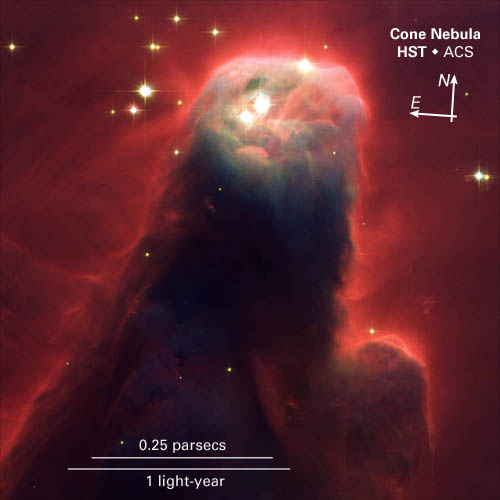
Stars are forming in the gigantic dust pillar called the Cone Nebula.
Cones,
pillars, and majestic
flowing shapes abound in
stellar
nurseries where natal clouds of gas and dust are buffeted by
energetic winds from newborn stars.
The
Cone Nebula,
a well-known example, lies within the bright
galactic star-forming region
NGC 2264.
The
Cone
was captured in unprecedented detail in
this close-up composite
of several observations from the Earth-orbiting
Hubble Space Telescope.
While the
Cone Nebula,
about 2,500 light-years away
in Monoceros,
is around 7 light-years long,
the region pictured here
surrounding the cone's blunted head is a mere 2.5 light-years across.
In
our neck of the galaxy
that distance is just over half way
from the Sun to its nearest stellar neighbor, the
Alpha Centauri star system.
The massive star
NGC 2264 IRS, seen by Hubble's infrared camera
in 1997, is the likely source of the wind
sculpting the Cone Nebula and lies off the top of the image.
The
Cone Nebula's reddish veil is
produced by glowing hydrogen gas.

A Green Flash from the Sun
Image Credit & Copyright:
Daniel López
(El Cielo de Canarias)
Explanation:
Many think it is just a
myth.
Others think it is true but its cause isn't known.
Adventurers pride themselves on having seen it.
It's a
green flash from the
Sun.
The truth is the
green flash
does exist and its cause is well understood.
Just as the setting
Sun disappears completely from view,
a last glimmer appears startlingly
green.
The effect is typically visible only from locations with a low,
distant horizon, and lasts just a few seconds.
A
green flash is also visible for a rising
Sun, but takes better timing to spot.
A dramatic
green flash, as well as an even more rare
red flash, was caught in the
above photograph recently
observed
during a sunset visible from the
Observatorio del Roque de Los Muchachos in the
Canary Islands,
Spain.
The
Sun itself does
not turn
partly
green or red --
the effect is caused by layers of the
Earth's atmosphere acting like a
prism.
M16 and the Eagle Nebula
Image Credit &
Copyright:
Adam Block,
Mt. Lemmon SkyCenter,
Univ. Arizona
Explanation:
A star cluster around 2 million years young,
M16 is surrounded
by natal clouds of dust and glowing gas
also known as The Eagle Nebula.
This beautifully
detailed
image of the region includes
cosmic sculptures
made famous in
Hubble Space Telescope close-ups of the starforming complex.
Described as elephant trunks or
Pillars of Creation, dense,
dusty columns rising near the center are light-years in length but
are gravitationally contracting
to
form stars.
Energetic radiation from the cluster stars erodes material near
the tips, eventually exposing the embedded new stars.
Extending from the left edge of the frame is another dusty
starforming column known as the
Fairy
of Eagle Nebula.
M16 and the Eagle Nebula lie about 7,000 light-years away,
an easy target for binoculars or small telescopes in a
nebula rich part of the sky
toward the split constellation
Serpens Cauda
(the tail of the snake).

How to Identify that Light in the Sky
Image Credit & Copyright:
HK (The League of Lost Causes)
Explanation:
What is that light in the sky?
Perhaps one of humanity's more common questions,
an answer may result from a few quick observations.
For example -- is it moving or blinking?
If so, and if you live near a city,
the answer is typically an airplane,
since planes are so numerous and so few stars and
satellites are bright enough to be seen over the din of
artificial city lights.
If not, and if you live far from a city, that bright light is likely a planet such as
Venus or
Mars --
the former of which is constrained to appear near the horizon just before dawn or after dusk.
Sometimes the low apparent motion of a distant
airplane near the horizon makes it hard to tell from a
bright planet,
but even this can usually be discerned by the plane's motion over a few minutes.
Still unsure?
The
above chart gives a sometimes-humorous but mostly-accurate assessment.
Dedicated sky enthusiasts will likely note -- and are
encouraged to provide --
polite corrections.
Source - NASA