Monday, July 13, 2015

NASA Latest Images


MyCn18: An Hourglass Planetary Nebula
Image Credit: R. Sahai and J. Trauger (JPL), WFPC2, HST, NASA
Explanation: The sands of time are running out for the central star of this hourglass-shaped planetary nebula. With its nuclear fuel exhausted, this brief, spectacular, closing phase of a Sun-like star's life occurs as its outer layers are ejected - its core becoming a cooling, fading white dwarf. In 1995, astronomers used the Hubble Space Telescope (HST) to make a series of images of planetary nebulae, including the one above. Here, delicate rings of colorful glowing gas (nitrogen-red, hydrogen-green, and oxygen-blue) outline the tenuous walls of the hourglass. The unprecedented sharpness of the HST images has revealed surprising details of the nebula ejection process that are helping to resolve the outstanding mysteries of the complex shapes and symmetries of planetary nebulas.


Gravitational Anomalies of Mercury
Image Credit: NASA, GSFC's SVS, JHU's APL, Carnegie Inst. Washington
Explanation: What's that under the surface of Mercury? The robotic MESSENGER spacecraft that had been orbiting planet Mercury for the past four years had been transmitting its data back to Earth with radio waves of very precise energy. The planet's gravity, however, slightly changed this energy when measured on Earth, which enabled the reconstruction of a gravity map of unprecedented precision. Here gravitational anomalies are shown in false-color, superposed on an image of the planet's cratered surface. Red hues indicate areas of slightly higher gravity, which in turn indicates areas that must have unusually dense matter under the surface. The central area is Caloris Basin, a huge impact feature measuring about 1,500 kilometers across. Last week, after completing its mission and running low on fuel, MESSENGER was purposely crashed onto Mercury's surface.


When Vega is North
Image Credit & Copyright: Miguel Claro | Dark Sky Alqueva
Explanation: In only about 12,000 years Vega will be the North Star, the closest bright star to our fair planet's North Celestial Pole. By then, when you fix your camera to a tripod long exposures of the night sky will show the concentric arcs of star trails centered on a point near Vega as Earth rotates on its axis. Of course, presently the bright star conveniently near the North Celestial Pole is Polaris, but that will change as the Earth's axis of rotation precesses, like the wobble of a spinning top with a precession period of about 26,000 years. If your camera is ready now and you don't want to wait 12,000 years for Vega to be the North Star, consider this ingenious demonstration of contemporary star trails (left) versus star trails reminiscent of the year 14000 CE. Both were recorded this April at the Alqueva Dark Sky Reserve in Alentejo, Portugal. To produce the more Vega-centric star trails of the distant future, astronomer Miguel Claro combined the rotation of two startracking camera mounts to create the apparent shift in the North Celestial Pole. (Addendum: Thanks to APOD readers who note that when Vega is the North Star it will also appear near the same position that Polaris is now relative to the landscape.)


Trio Leo
Image Credit & Copyright: Philippe Durville
Explanation: This popular group is famous as the Leo Triplet - a gathering of three magnificent galaxies in one field of view. Crowd pleasers when imaged with even modest telescopes, they can be introduced individually as NGC 3628 (left), M66 (bottom right), and M65 (top). All three are large spiral galaxies but they tend to look dissimilar because their galactic disks are tilted at different angles to our line of sight. NGC 3628 is seen edge-on, with obscuring dust lanes cutting across the plane of the galaxy, while the disks of M66 and M65 are both inclined enough to show off their spiral structure. Gravitational interactions between galaxies in the group have also left telltale signs, including the warped and inflated disk of NGC 3628 and the drawn out spiral arms of M66. This gorgeous view of the region spans about one degree (two full moons) on the sky. The field covers over 500 thousand light-years at the trio's estimated distance of 30 million light-years.


The Sky from Mauna Kea
Image Credit & Copyright: Shane Black Photography; Rollover Annotation: Judy Schmidt
Explanation: What if you could stand at the top of a volcano and peer out across the universe? If the timing is right, you might see an amazing panorama like the one featured here. In this case, the volcano is the Hawaii's Mauna Kea, and the time was a clear night last summer In the foreground of this south-facing panorama lies a rugged landscape dotted with rocks and hardy plants. Slightly above and further out, a white blanket of clouds spreads horizontally to the horizon, seemingly dividing heaven and Earth. City lights illuminate the clouds and sky on the far left, while orange lava in the volcanic caldera of Kilauea lights up the clouds just left of center. The summit of an even more distant Hawaiian volcano, Mauna Loa, is visible in dark silhouette near the central horizon. Green airglow is visible above the clouds, caused by air molecules excited by the Sun during the day. The Moon is the bright orb on the right. A diffuse band of light-colored zodiacal light extends up from the far right. Most distant, the dramatic central band of our Milky Way Galaxy appears to rise vertically from Mauna Loa. The person who witnessed and captured this breathtaking panorama stands before you in the image center.


The Magnificent Horsehead Nebula
Image Credit & Copyright: Data: Giuseppe Carmine Iaffaldano; Processing: Roberto Colombari
Explanation: Sculpted by stellar winds and radiation, a magnificent interstellar dust cloud by chance has assumed this recognizable shape. Fittingly named the Horsehead Nebula, it is some 1,500 light-years distant, embedded in the vast Orion cloud complex. About five light-years "tall", the dark cloud is cataloged as Barnard 33 and is visible only because its obscuring dust is silhouetted against the glowing red emission nebula IC 434. Stars are forming within the dark cloud. Contrasting blue reflection nebula NGC 2023, surrounding a hot, young star, is at the lower left. The gorgeous featured image combines both narrowband and broadband images.


Dwarf Planet, Bright Spot
Image Credit: NASA, JPL-Caltech, UCLA, MPS/DLR/IDA
Explanation: Now at Ceres, Dawn's camera recorded this closer view of the dwarf planet's northern hemisphere and one of its mysterious bright spots on May 4. A sunlit portrait of a small, dark world about 950 kilometers in diameter, the image is part of a planned sequence taken from the solar-powered spacecraft's 15-day long RC3 mapping orbit at a distance of 13,600 kilometers (8,400 miles). The animated sequence shows Ceres' rotation, its north pole at the top of the frame. Imaged by Hubble in 2004 and then by Dawn as it approached Ceres in 2015, the bright spot itself is revealed to be made up of smaller spots of reflective material that could be exposed ice glinting in the sunlight. On Saturday, Dawn's ion propulsion system was turned on to spiral the spacecraft into a closer 4,350-kilometer orbit by June 6. Of course another unexplored dwarf planet, Pluto, is expecting the arrival of a visitor from Earth, the New Horizons spacecraft, by mid-July.


Jupiter, Ganymede, Great Red Spot
Image Credit & Copyright: Damian Peach/SEN
Explanation: In this sharp snapshot, the Solar System's largest moon Ganymede poses next to Jupiter, the largest planet. Captured on March 10 with a small telescope from our fair planet Earth, the scene also includes Jupiter's Great Red Spot, the Solar System's largest storm. In fact, Ganymede is about 5,260 kilometers in diameter. That beats out all three of its other fellow Galilean satellites, along with Saturn's Moon Titan at 5,150 kilometers and Earth's own Moon at 3,480 kilometers. Though its been shrinking lately, the Great Red Spot's diameter is still around 16,500 kilometers. Jupiter, the Solar System's ruling gas giant, is about 143,000 kilometers in diameter at its equator. That's nearly 10 percent the diameter of the Sun.


Ares 3 Landing Site: The Martian Revisited
Image Credit: HiRISE, MRO, LPL (U. Arizona), NASA
Explanation: This close-up from the Mars Reconnaissance Orbiter's HiRISE camera shows weathered craters and windblown deposits in southern Acidalia Planitia. A striking shade of blue in standard HiRISE image colors, to the human eye the area would probably look grey or a little reddish. But human eyes have not gazed across this terrain, unless you count the eyes of NASA astronauts in the scifi novel The Martian by Andy Weir. The novel chronicles the adventures of Mark Watney, an astronaut stranded at the fictional Mars mission Ares 3 landing site corresponding to the coordinates of this cropped HiRISE frame. For scale Watney's 6-meter-diameter habitat at the site would be about 1/10th the diameter of the large crater. Of course, the Ares 3 landing coordinates are only about 800 kilometers north of the (real life) Carl Sagan Memorial Station, the 1997 Pathfinder landing site.


A Cliff Looming on Comet 67P
Image Credit & Licence: ESA, Rosetta, NAVCAM
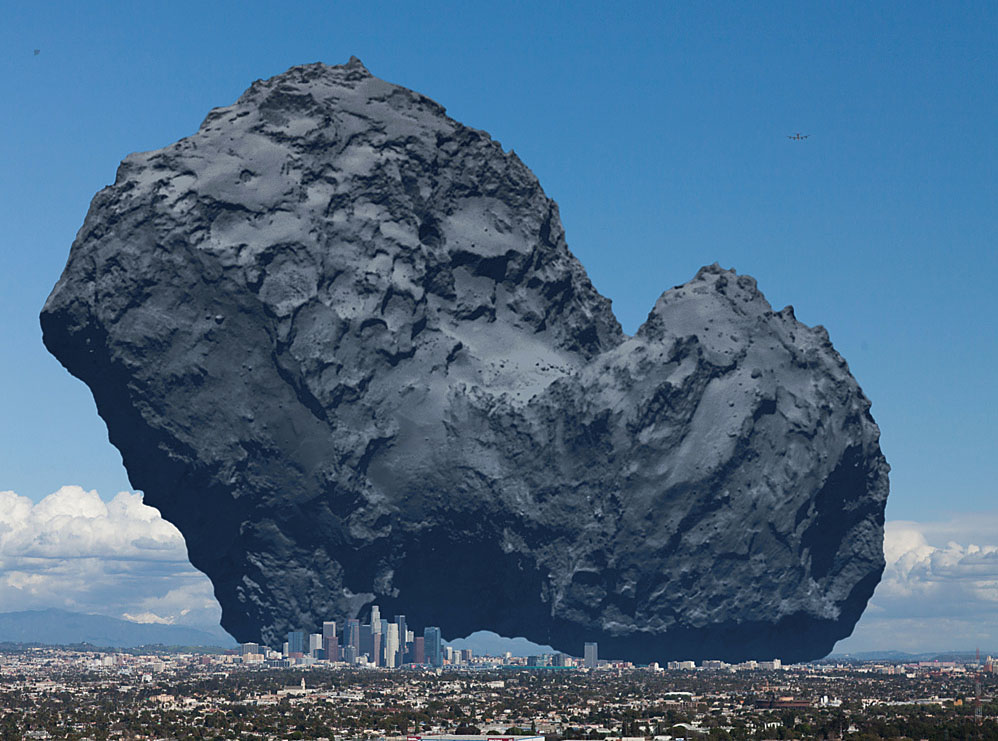
Explanation: What's that looming behind this gravel-strewn hill on Comet Churyumov–Gerasimenko? A jagged cliff. The unusual double-lobed nucleus of Comet 67P/Churyumov–Gerasimenko lends itself to unusual and dramatic vistas, another of which has been captured by the Rosetta spacecraft that arrived at the comet last September. The featured cometscape, taken last October and digitally enhanced, spans about 850 meters across. Meanwhile, Comet Churyumov–Gerasimenko continues to sprout jets as it nears its closest approach to the Sun in August. Along the way, Rosetta will continue listening for signals from Philae, a probe that landed on the nucleus but rebounded to an unknown surface location last November. If newly exposed to sunlight, Philae might regain enough energy to again signal Rosetta.

Source - NASA

NASA Images Latest


M51: The Whirlpool Galaxy
Image Credit & Copyright: Martin Pugh
Explanation: Follow the handle of the Big Dipper away from the dipper's bowl until you get to the handle's last bright star. Then, just slide your telescope a little south and west and you might find this stunning pair of interacting galaxies, the 51st entry in Charles Messier famous catalog. Perhaps the original spiral nebula, the large galaxy with well defined spiral structure is also cataloged as NGC 5194. Its spiral arms and dust lanes clearly sweep in front of its companion galaxy (right), NGC 5195. The pair are about 31 million light-years distant and officially lie within the angular boundaries of the small constellation Canes Venatici. Though M51 looks faint and fuzzy to the eye, deep images like this one can reveal striking colors and the faint tidal debris around the smaller galaxy


Cluster and Starforming Region Westerlund 2
Image Credit & Copyright: NASA, ESA, the Hubble Heritage Team
(STScI / AURA), A. Nota (ESA/STScI), and the Westerlund 2 Science Team
Explanation: Located 20,000 light-years away in the constellation Carina, the young cluster and starforming region Westerlund 2 fills this cosmic scene. Captured with Hubble's cameras in near-infrared and visible light, the stunning image is a celebration of the 25th anniversary of the launch of the Hubble Space Telescope on April 24, 1990. The cluster's dense concentration of luminous, massive stars is about 10 light-years across. Strong winds and radiation from those massive young stars have sculpted and shaped the region's gas and dust, into starforming pillars that point back to the central cluster. Red dots surrounding the bright stars are the cluster's faint newborn stars, still within their natal gas and dust cocoons. But brighter blue stars scattered around are likely not in the Westerlund 2 cluster and instead lie in the foreground of the Hubble anniversary field of view.


Blue Tears and the Milky Way
Image Credit & Copyright: Rogelio Bernal Andreo (Deep Sky Colors)
Explanation: Lapping at rocks along the shore of the Island of Nangan, Taiwan, planet Earth, waves are infused with a subtle blue light in this sea and night skyscape. Composed of a series of long exposures made on April 16 the image captures the faint glow from Noctiluca scintillans. Also known as sea sparkles or blue tears, the marine plankton's bioluminescence is stimulated by wave motion. City lights along the coast of mainland China shine beneath low clouds in the west but stars and the faint Milky Way still fill the night above. Over the horizon the galaxy's central bulge and dark rifts seem to echo the rocks and luminous waves.


Planetary Nebula Mz3: The Ant Nebula
Image Credit: R. Sahai (JPL) et al., Hubble Heritage Team, ESA, NASA
Explanation: Why isn't this ant a big sphere? Planetary nebula Mz3 is being cast off by a star similar to our Sun that is, surely, round. Why then would the gas that is streaming away create an ant-shaped nebula that is distinctly not round? Clues might include the high 1000-kilometer per second speed of the expelled gas, the light-year long length of the structure, and the magnetism of the star visible above at the nebula's center. One possible answer is that Mz3 is hiding a second, dimmer star that orbits close in to the bright star. A competing hypothesis holds that the central star's own spin and magnetic field are channeling the gas. Since the central star appears to be so similar to our own Sun, astronomers hope that increased understanding of the history of this giant space ant can provide useful insight into the likely future of our own Sun and Earth.


Space Station over Lunar Terminator
Image Credit & Copyright: Dani Caxete
Explanation: What's that in front of the Moon? It's the International Space Station. Using precise timing, the Earth-orbiting space platform was photographed in front of a partially lit Moon last year. The featured image was taken from Madrid, Spain with an exposure time of only 1/1000 of a second. In contrast, the duration of the transit of the ISS across the entire Moon was about half a second. The sun-glinting station can be seen just to the dark side of the day / night line known as the terminator. Numerous circular craters are visible on the distant Moon, as well as comparatively rough, light colored terrain known as highlands, and relatively smooth, dark colored areas known as maria. On-line tools can tell you when the International Space Station will be visible from your area.


Massive Nearby Spiral Galaxy NGC 2841
Image Credit: Hubble, Subaru; Composition & Copyright: Roberto Colombari
Explanation: It is one of the more massive galaxies known. A mere 46 million light-years distant, spiral galaxy NGC 2841 can be found in the northern constellation of Ursa Major. This sharp view of the gorgeous island universe shows off a striking yellow nucleus and galactic disk. Dust lanes, small, pink star-forming regions, and young blue star clusters are embedded in the patchy, tightly wound spiral arms. In contrast, many other spirals exhibit grand, sweeping arms with large star-forming regions. NGC 2841 has a diameter of over 150,000 light-years, even larger than our own Milky Way and captured by this composite image merging exposures from the orbiting 2.4-meter Hubble Space Telescope and the ground-based 8.2-meter Subaru Telescope. X-ray images suggest that resulting winds and stellar explosions create plumes of hot gas extending into a halo around NGC 2841.


Comet Churyumov Gerasimenko in Crescent
Image Credit: ESA, Rosetta, NAVCAM; processing by Giuseppe Conzo
Explanation: What's happening to Comet 67P/Churyumov–Gerasimenko? As the 3-km wide comet moves closer to the Sun, heat causes the nucleus to expel gas and dust. The Rosetta spacecraft arrived at the comet's craggily double nucleus last July and now is co-orbiting the Sun with the giant dark iceberg. Recent analysis of data beamed back to Earth from the robotic Rosetta spacecraft has shown that water being expelled by 67P has a significant difference with water on Earth, indicating that Earth's water could not have originated from ancient collisions with comets like 67P. Additionally, neither Rosetta nor its Philae lander detected a magnetic field around the comet nucleus, indicating that magnetism might have been unimportant in the evolution of the early Solar System. Comet 67P, shown in a crescent phase in false color, should increase its evaporation rate as it nears its closest approach to the Sun in 2015 August, when it reaches a Sun distance just a bit further out than the Earth.


Across the Sun
Image Credit & Copyright: Göran Strand
Explanation: A long solar filament stretches across the relatively calm surface of the Sun in this telescopic snap shot from April 27. The negative or inverted narrowband image was made in the light of ionized hydrogen atoms. Seen at the upper left, the magnificent curtain of magnetized plasma towers above surface and actually reaches beyond the Sun's edge. How long is the solar filament? About as long as the distance from Earth to Moon, illustrated by the scale insert at the left. Tracking toward the right across the solar disk a day later the long filament erupted, lifting away from the Sun's surface. Monitored by Sun staring satellites, a coronal mass ejection was also blasted from the site but is expected to swing wide of our fair planet.


MESSENGER's Last Day on Mercury
Image Credit: NASA, Johns Hopkins Univ. APL, Arizona State Univ., CIW
Explanation: The first to orbit Mercury, the MESSENGER spacecraft came to rest on this region of Mercury's surface yesterday. Constructed from MESSENGER image and laser altimeter data, the scene looks north over the northeastern rim of the broad, lava filled Shakespeare basin. The large, 48 kilometer (30 mile) wide crater Janacek is near the upper left edge. Terrain height is color coded with red regions about 3 kilometers above blue ones. MESSENGER'S final orbit was predicted to end near the center, with the spacecraft impacting the surface at nearly 4 kilometers per second (over 8,700 miles per hour) and creating a new crater about 16 meters (52 feet) in diameter. The impact on the far side of Mercury was not observed by telescopes, but confirmed when no signal was detected from the spacecraft given time to emerge from behind the planet. Launched in 2004, the MErcury Surface, Space ENvironment, GEochemisty and Ranging spacecraft completed over 4,000 orbits after reaching the Solar System's innermost planet in 2011.

Source - NASA

Saturday, July 11, 2015

NASA Mars Trek lets you examine the Red Planet right on your computer


US space agency NASA has released a Google Earth like tool for Mars dubbed ‘Mars Trek‘ which it pegs as an outreach product geared towards students and members of the general public who intend to garner knowledge above and beyond what they already know about the red planet.

Those who are familiar with Google Earth will find ‘Mars Trek’ as an equally fantastic map for Mars providing high-definition views of extraordinary landmarks on the red planet, such as Olympus Mons, the largest-known volcano in the solar system.

Users have the option of navigating Mars in 2D as well as 3D and the zoomable map ensures a highly detailed view of the global view as well as both the north and south poles.

NASA describes Mars Trek as a web-based portal for exploration of Mars that provides users with information about various sites on the Red Planet through data that it has collected over the years at various landing sites.

Users will also get access to set of tools including 3D printing, elevation profiles, sun angle calculations, Sun and Earth position, as well as bookmarks for the exploration area by the following NASA missions: Mars Science Laboratory (MSL); Mars Exploration Rovers (MER); Phoenix; and Pathfinder.

NASA said that there will be updates to this map and it will include more technical information appropriate for scientists and advanced students, as well as modules that are more introductory in nature as entry points for the general public.