Explanation:
On Saturn, the rings tell you the season.
On Earth, today marks a
solstice, the time when the
Earth's spin axis
tilts directly toward the Sun.
On Earth's northern hemisphere, today is the
Summer Solstice,
the day of maximum daylight.
Since Saturn's grand rings orbit along the planet's
equator,
these rings appear
most prominent -- from the direction of the Sun --
when the Saturn's spin axis points toward the Sun.
Conversely, when Saturn's spin axis points to the side, an
equinox occurs and the
edge-on rings are
hard to see.
In the featured montage,
images of Saturn
over the past 11 years have been superposed to show the
giant planet
passing from southern summer toward northern summer.
Although Saturn will only reach its northern summer solstice in
2017 May,
the image of Saturn most analogous to today's Earth solstice is the bottommost one.
Explanation:
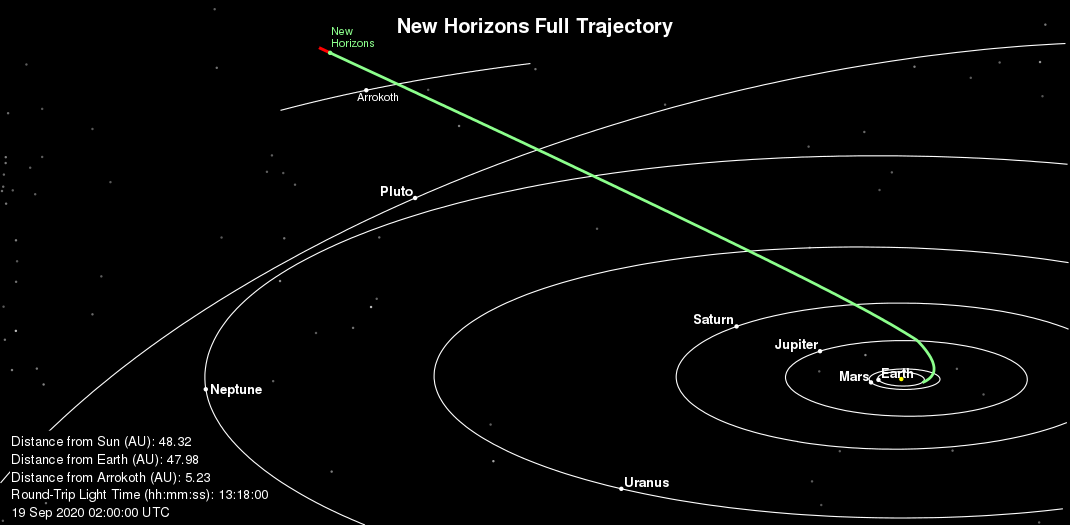
In three weeks, the robotic New Horizons spacecraft will reach Pluto.
As the
featured video
makes clear, though, humanity has been on an unprecedented
epoch of robotic exploration of
our Solar System's planets for the past half century.
The video highlights artistic illustrations of
Mariner 2 flying by Venus in 1962,
Mariner 4 flying past Mars in 1965,
Pioneer 10 flying past
Jupiter in 1973,
Mariner 10 flying past
Mercury in 1974,
Pioneer 11 flying past
Saturn in 1979, and
Voyager2 flying past
Uranus in 1986 and then
Neptune in 1989.
Next is a hypothetical sequence depicting
New Horizons flying past Pluto next month.
Assuming things work as planned,
dwarf planet
Pluto will then become the
farthest world yet explored by humans.
Of course, these
Pluto illustrations are only a guess.
How Pluto and its moons will really look may be a mixture of familiar things, such as
craters, and unfamiliar things, such as …
Explanation:
What are those colorful rings around the Moon?
A corona.
Rings like this will sometimes appear when the Moon is seen through thin clouds.
The effect is created by the quantum mechanical
diffraction of light around individual, similarly-sized water droplets in an
intervening
but mostly-transparent cloud.
Since light of different colors has
different wavelengths,
each color diffracts differently.
Lunar Coronae are one of the few
quantum mechanical color effects that can be
easily seen with the unaided eye.
The
featured lunar corona was captured around a
Strawberry Moon on June 2 from
La Plata,
Argentina.
Similar coronae that form around the Sun are typically harder to see because of the Sun's great brightness.
Explanation:
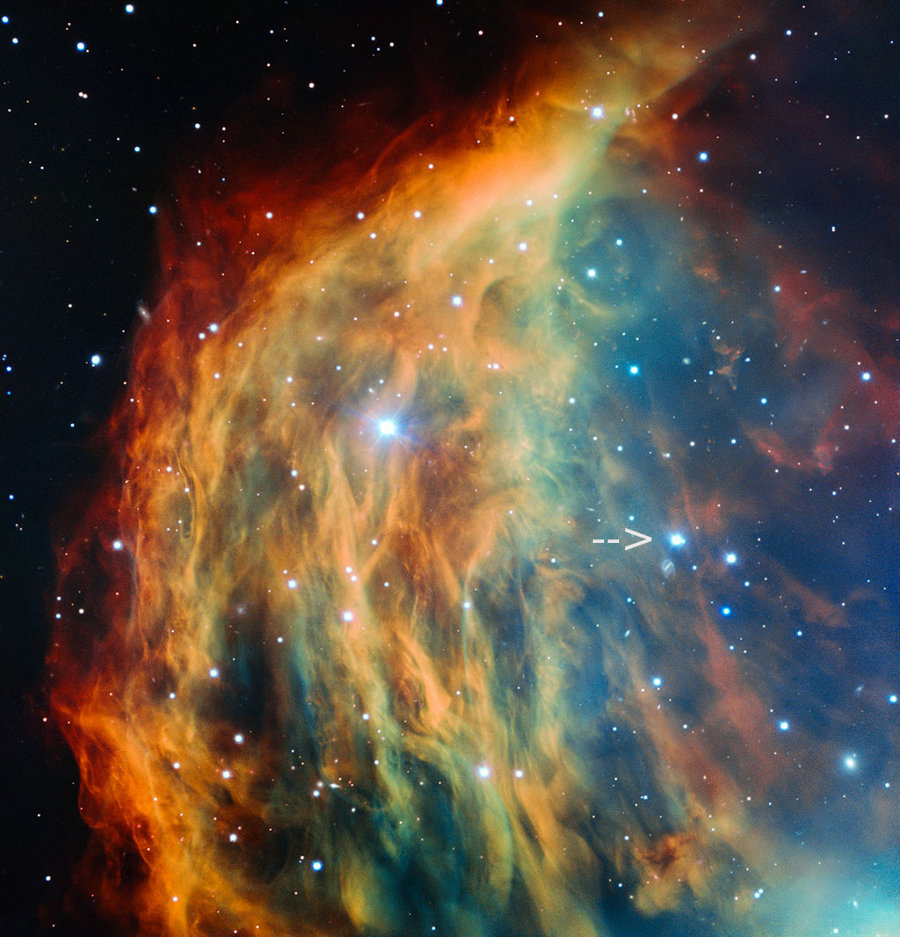
Braided, serpentine filaments of glowing gas
suggest this nebula's popular name, The Medusa Nebula.
Also known as Abell 21, this Medusa is an old
planetary nebula
some 1,500 light-years away along the southern border of the constellation
Gemini.
Like its mythological
namesake, the nebula is associated with a dramatic transformation.
The planetary
nebula phase represents a final stage in
the
evolution of low mass stars
like the
sun, as they transform themselves from
red giants
to hot white dwarf stars and in the process shrug off their outer layers.
Ultraviolet
radiation
from the hot star powers the nebular glow.
An unrelated, bright, foreground star is near center in this
close-up,
telescopic view,
while the Medusa's transforming central star is actually the dimmer
star below center and toward the right-hand part
of the frame.
The Medusa Nebula is estimated to be over 4 light-years across.
Explanation:
Shortly before Mars' June 2015 conjunction, the Curiosity Rover
celebrated 1000 sols
on the red planet.
After its August 5, 2012 landing, Curiosity's 1000th sol
or martian day on the surface corresponded
to planet Earth's
calendar
date May 31, 2015.
Because the line-of-sight to
Mars is close to the Sun near
the conjunction, radio communications are affected
and the six-wheeled, car-sized robotic rover cautiously remains
parked at this spot for now.
The view looks back toward the
stomping
grounds for Curiosity's
nearly 10.6 kilometer trek so far, with the hazy rim of Gale Crater
looming in the distance.
The mosaicked panorama was constructed with images from
navigation cameras taken on Curiosity's sol 997.
Explanation:
Why do many galaxies appear as
spirals?
A striking example is
M101,
shown above,
whose relatively close distance of about 27 million
light years allows it to be studied in some detail.
Observational evidence indicates that a
close gravitational interaction with a neighboring galaxy created
waves of high mass and condensed gas which
continue to orbit the galaxy center.
These
waves compress existing gas and cause
star formation.
One result is that
M101, also called the
Pinwheel Galaxy, has several extremely
bright star-forming regions
(called HII regions) spread across its spiral arms.
M101 is so large that its
immense gravity distorts
smaller nearby galaxies.
APOD is 20 Years Old Today Image Credit & Copyright: Apologies to:
Vermeer's
Astronomer and
Geographer;
Image Pixelation: Rob Stevenson
Explanation:
Welcome to the
vicennial year of the Astronomy Picture of the Day!
Perhaps a source of web consistency for some,
APOD is still here.
As during each of the 20 years of selecting images, writing text, and editing the
APOD
web pages, the occasionally industrious Robert Nemiroff (left) and
frequently persistent Jerry Bonnell (right) are pictured above plotting
to highlight yet another unsuspecting image of our cosmos.
Although the featured image may appear similar to the whimsical
Vermeer composite that ran on
APOD's fifth anniversary, a perceptive eye might catch that it has been digitally re-pixelated using many of the
over 5,000 APOD images that have
appeared
over APOD's tenure.
(Can you find any notable APOD images?)
Once again, we at APOD would like to offer a sincere thank you to our
readership for continued interest, support, and many gracious communications.
If you consider yourself a fan of APOD, you might want to consider joining the
Friends of APOD.
Sharpless 308: Star Bubble Image Credit & Copyright: Kfir Simon
Explanation:
Blown by fast winds from a hot, massive star,
this cosmic bubble is huge.
Cataloged as
Sharpless 2-308
it lies some 5,200 light-years away toward the constellation of
the Big Dog (Canis Major)
and covers slightly more of the sky than a Full Moon.
That corresponds
to a diameter of 60 light-years at its estimated
distance.
The massive star that created the bubble, a
Wolf-Rayet star,
is the bright one near the center of the nebula.
Wolf-Rayet stars have over 20 times the mass of the Sun and
are thought to be in a brief,
pre-supernova phase of massive star
evolution.
Fast winds from this Wolf-Rayet star create the
bubble-shaped nebula
as they sweep up slower moving material from an earlier phase of evolution.
The windblown nebula has an age of
about
70,000 years.
Relatively faint emission captured in the expansive image
is dominated by the glow of ionized oxygen atoms
mapped to a blue hue.
Explanation: What
bizarre alien planet is this ?
It's planet Earth of course,
seen through the shimmering glow of
aurorae from the
International Space Station.
About 400 kilometers (250 miles) above,
the orbiting station is itself within
the upper realm of
the auroral displays, also watched from the
planet's surface on June 23rd.
Aurorae have the
signature colors of
excited molecules and
atoms at the low densities found at extreme altitudes.
The eerie greenish glow of molecular oxygen dominates
this view.
But higher, just above the space station's horizon, is a rarer red band
of aurora from atomic oxygen.
The ongoing geomagnetic storm
began after a
coronal mass ejection's recent impact on Earth's magnetosphere.
Explanation:
Rising at the start of a northern summer's night, these
three bright stars form the familiar asterism known as
the Summer Triangle.
Altair, Deneb, and Vega
are the alpha stars of their respective constellations, Aquila, Cygnus,
and Lyra, nestled near the Milky Way.
Close in apparent brightness the three do look similar in these
telescopic portraits,
but all have
their own
stellar stories.
Their similar appearance hides the fact that
the Summer Triangle stars actually span a large range in
intrinsic luminosity and distance.
A main sequence
dwarf star, Altair is some 10 times brighter
than the Sun and 17 light-years away, while
Vega, also a hydrogen-fusing dwarf, is around 30 times brighter than
the Sun and lies 25 light-years away.
Supergiant Deneb, at about 54,000 times the solar luminosity,
lies some 1,400 light-years distant.
Of course, with a whitish blue hue,
the stars of the Summer Triangle are all hotter than
the Sun.
Explanation:
How do sunspots evolve?
Large dark
sunspots -- and the active regions that contain them -- may last for weeks, but all during that time they are constantly changing.
Such variations were particularly apparent a few weeks ago as the active region
AR 2339
came around the limb of the Sun and was tracked for the next 12 days by NASA's
Solar Dynamic Observatory.
In the
featured time lapse video,
some sunspots drift apart, while others merge.
All the while, the dark central
umbral regions
shift internally and their surrounding lighter penumbras shimmer and wave.
The surrounding
Sun
appears to flicker as the carpet of yellow
granules come and go on the time scale of hours.
In general, sunspots
are relatively cool regions where the local
magnetic field
pokes through the Sun's surface and inhibits heating.
Over the past week, an even more active region --
AR 2371 -- has been crossing the Sun and releasing powerful flares that have resulted in
impressive auroras here on Earth.
Pluto nearly fills the frame in this image from the
Long Range Reconnaissance Imager (LORRI) aboard NASA’s New Horizons
spacecraft, taken on July 13, 2015 when the spacecraft was 476,000 miles
(768,000 kilometers) from the surface. This is the last and most
detailed image sent to Earth before the spacecraft’s closest approach to
Pluto on July 14. The color image has been combined with
lower-resolution color information from the Ralph instrument that was
acquired earlier on July 13. This view is dominated by the large, bright
feature informally named the “heart,” which measures approximately
1,000 miles (1,600 kilometers) across. The heart borders darker
equatorial terrains, and the mottled terrain to its east (right) are
complex. However, even at this resolution, much of the heart’s interior
appears remarkably featureless—possibly a sign of ongoing geologic
processes.
Explanation:
Is this galaxy jumping through a giant ring of stars?
Probably not.
Although the precise
dynamics behind
the featured image is yet unclear, what is clear is that the pictured galaxy,
NGC 7714,
has been stretched and distorted by a recent collision with a neighboring galaxy.
This smaller neighbor,
NGC 7715,
situated off to the left of the featured frame, is thought to have charged right through
NGC 7714.
Observations indicate that the golden
ring pictured is composed of millions of older Sun-like stars
that are likely co-moving with the interior bluer stars.
In contrast, the bright center of
NGC 7714
appears to be undergoing a burst of new star formation.
NGC 7714 is located about 100 million
light years
away toward the constellation of the Fish
(Pisces).
The interactions between these galaxies
likely started about 150 million
years ago
and should continue for several hundred million
years more, after which a
single central galaxy may result.
The Milky Way over the Temple of Poseidon Image Credit & Copyright: Alexandros Maragos;
Rollover Annotation: Judy Schmidt
Explanation:
What's that glowing in the distance?
Although it may look like a
lighthouse, the rays of light near the horizon actually emanate from the
Temple of Poseidon at
Cape Sounion,
Greece.
Some temple
lights are even reflected in the
Aegean Sea in the foreground.
Although meant to be a monument to the sea, in this image,
the temple's lights seem to be pointing out locations on the sky.
For example, the wide ray toward the right fortuitously points toward the
Lagoon Nebula in the central band of our
Milky Way, which runs diagonally down the image from the upper left.
Also, the nearly vertical beam seems to point toward the star clouds near the direction of the
Wild Duck open cluster of stars.
The featured image was taken less than three weeks ago.
Explanation:
Telescopic observers on Earth have been treated to spectacular
views of Saturn lately as the ringed planet reached its 2015
opposition on May 23 at 0200 UT.
Of course opposition means opposite the Sun in Earth's sky.
So near
opposition Saturn is
up all night, at its closest and brightest
for the year.
These sharp images
taken within hours of the Sun-Earth-Saturn
alignment also show the strong brightening of Saturn's rings
known as the opposition surge or the
Seeliger Effect.
Directly illuminated, the ring's icy particles cast no shadows and
strongly backscatter sunlight toward planet Earth,
creating the dramatic surge in brightness.
Saturn currently stands in the
sky not far from bright Antares,
alpha star of the constellation Scorpius.
Explanation:
Many bright nebulae and star clusters in planet Earth's sky
are associated with the name of
astronomer
Charles Messier, from his famous 18th century catalog.
His
name is also given to these two large and remarkable craters
on the Moon.
Standouts in the dark, smooth lunar Sea of Fertility or Mare
Fecunditatis,
Messier (left) and Messier A have dimensions of 15 by 8
and 16 by 11 kilometers respectively.
Their elongated shapes are explained by
an extremely shallow-angle trajectory followed by
the impactor, moving left to right,
that gouged out the craters.
The shallow impact also resulted in two
bright rays of material
extending along the surface to the right, beyond the picture.
Intended to be viewed with
red/blue glasses (red for the left eye),
this striking stereo picture of the crater pair was recently created
from high resolution scans of two images
(AS11-42-6304,
AS11-42-6305)
taken during the Apollo 11 mission to the moon.
Explanation:
Why does this moon look like a sponge?
To better investigate,
NASA and
ESA sent the Saturn-orbiting robotic
spacecraft Cassini zooming past
Saturn's moon
Hyperion, once again, earlier this week.
One of the images beamed back to Earth is
featured above, raw and unprocessed.
Visible, as expected, are many
unusually shaped craters with an unusual dark material at the bottom.
Although Hyperion
spans about 250 kilometers, its small gravitational tug on
Cassini indicates that it is mostly empty space and so has very low
surface gravity.
Therefore, the
odd shapes of many of Hyperion's craters are thought to result from impacts that
primarily compress and eject surface material -- instead of the more
typical round craters that appear after a circular shock wave that explosively redistributes surface material.
Cassini is
on track for another flyby of
Saturn's
Dione in about two weeks.
Explanation:
Follow a sunset on a clear day against a distant horizon
and you might
glimpse
a green flash just as the Sun disappears, the sunlight
briefly refracted
over a long sight-line through atmospheric layers.
You can spot a green flash at sunrise too.
Pinpointing the exact place and time to see the rising Sun
peeking above the horizon is a little more difficult though, and
it can be harder still to catch a green flash from
the fainter rising Moon.
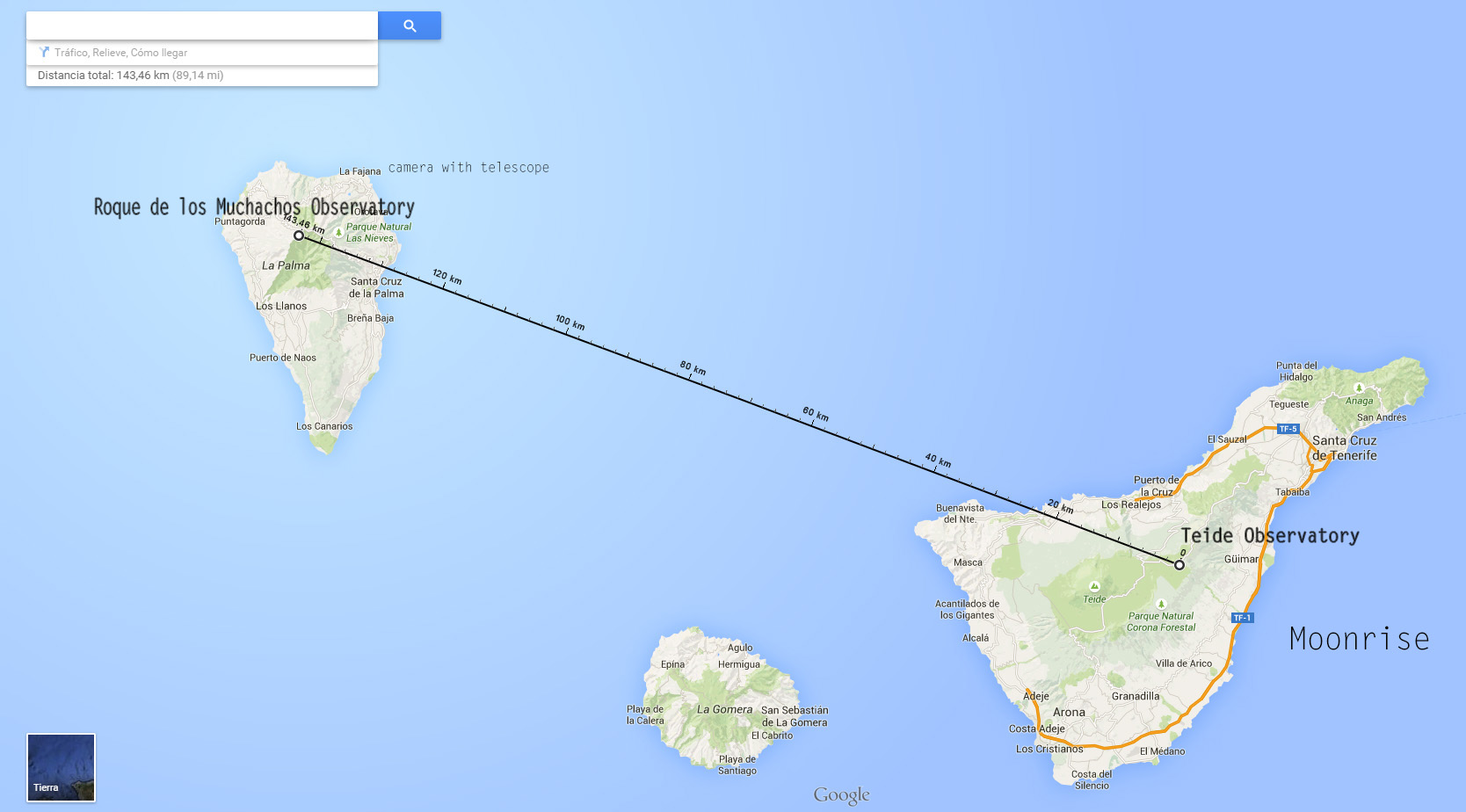
But well-planned snapshots did record a green flash at the
Full
Moon's upper edge on June 2nd,
from the Roque de los Muchachos Observatory
on the Canary Island of La Palma.
Looking a little south of due east,
this long telephoto view finds the rising Moon above mountains and
a sea of clouds.
In sunlit profile are the mountaintop
Teide Observatory telescope domes
on the island of Tenerife some
143 kilometers away.
Explanation:
What would it look like to fly over dwarf planet Ceres?
Animators from the
German Aerospace Center
recently took actual images and height data from NASA's robotic Dawn
mission -- currently visiting Ceres -- to generate several
fascinating virtual sequences.
The
featured video begins with a mock orbit around the 950-km wide space rock, with the crater featuring two of the
enigmatic white spots soon rotating into view.
The next sequences take the viewer around the
Ceres'
north and south poles, and then over a
limb of the dark world highlighting its heavily cratered surface.
Here,
terrain height on the
asteroid belt's largest object has been digitally doubled,
while an artificial star field has been added in the background.
The Dawnspacecraft
will likely remain an unusual
artificial moon of
Ceres long after its mission concludes.
Explanation:
It's the dim star, not the bright one, near the center of
NGC 3132 that created this odd but beautiful
planetary nebula.
Nicknamed the
Eight-Burst Nebula and the Southern
Ring Nebula, the glowing gas originated in the
outer layers of a star like our
Sun.
In this
representative
color picture, the hot blue pool of light seen surrounding this
binary system
is energized by the hot surface of the faint star.
Although
photographed to explore unusual symmetries, it's the asymmetries that
help make this
planetary nebula so intriguing.
Neither the unusual shape of the surrounding cooler
shell nor the structure and
placements of the cool filamentary
dust lanes running across
NGC 3132
are well understood.