Explanation:
Telescopes around the world are tracking a bright supernova that occurred in a nearby dusty galaxy.
The powerful stellar explosion was first noted earlier this month.
The nearby galaxy is the photogenic
Centaurus A,
visible with binoculars and known for impressive filaments of
light-absorbing dust that cross its center.
Cen A is featured here in a
high-resolution archival
Hubble Space Telescope
image, with an inset image featuring the
supernova taken from the ground only two days after discovery.
Designated
SN2016adj,
the supernova is highlighted with crosshairs in the inset, appearing just to the left of a bright foreground star in our
Milky Way Galaxy.
This supernova is currently thought to be of
Type IIb, a
stellar-core-collapse supernova,
and is of high interest because it occurred
so nearby
and because it is being seen through a known dust filament.
Current and future observations of
this supernova
may give us new clues about the fates of massive stars and how some
elements found on our Earth were formed.
Explanation:
What's lighting up the Cigar Galaxy?
M82, as this
irregular galaxy is also known, was stirred up by a
recent pass near large
spiral galaxy
M81.
This doesn't fully explain the source of the red-glowing outwardly
expanding gas, however.
Evidence indicates that this gas is being
driven out by the combined emerging
particle winds of many stars, together creating a galactic
superwind.
The featured photographic mosaic highlights a specific color of
red light strongly emitted by ionized
hydrogen gas, showing detailed filaments of this gas.
The filaments extend for over 10,000
light years.
The 12-million light-year distant
Cigar Galaxy is the
brightest galaxy in the sky in infrared light, and can be seen in visible light with a small
telescopetowards the constellation of the Great Bear
(Ursa Major).
Explanation:
Want to take a relaxing
interstellar
vacation?
Consider visiting
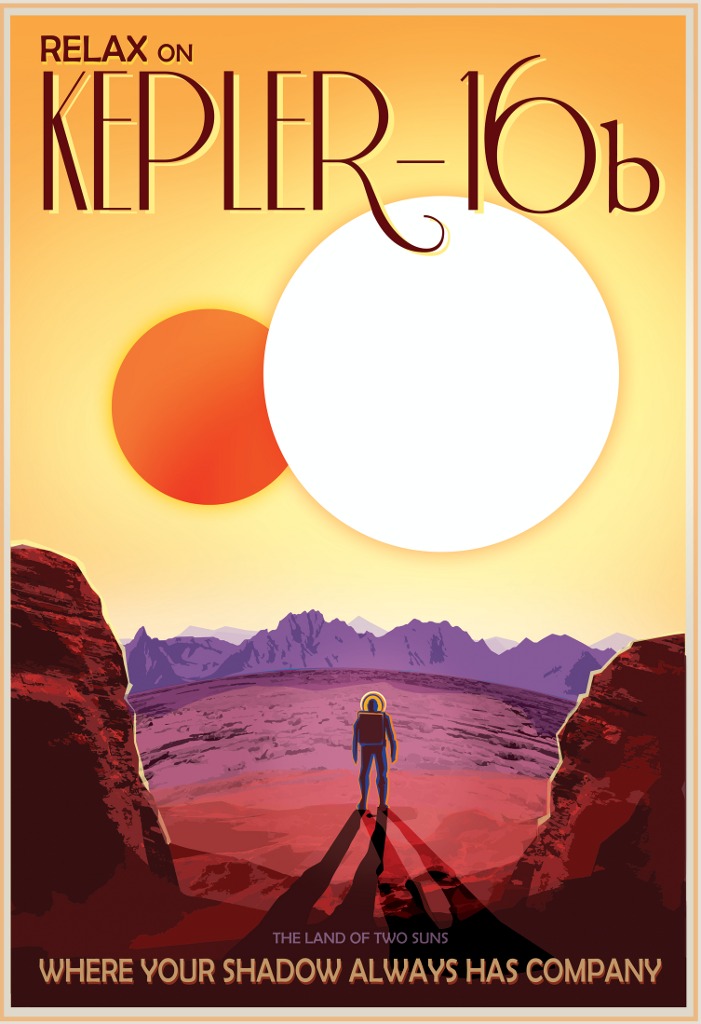
Kepler-16b,
a world in a binary star system.
In fact Kepler-16b is the first discovered
circumbinary planet.
It was detected in a wide 229 day orbit around a close pair of cool,
low-mass stars some 200 light-years away.
The parent stars eclipse one another in their orbits, observed as
a periodic dimming of starlight.
But Kepler-16b itself was
discovered by following the additional very slight dimming
produced during its transits.
Like sci-fi planet Tatooine of Star Wars fame,
two suns would set
over its horizon.
Still, Kepler-16b is probably not a Tatooine-like terrestrial
desert world.
Instead, Kepler-16b is thought to be a cold, uninhabitable
planet with about the mass of Saturn and a gaseous surface ...
so plan to dress accordingly.
Or, choose another
Visions of
the Future vacation destination.
Explanation:
Massive star IRS 4 is beginning to spread its wings.
Born only about 100,000 years ago,
material streaming out from this
newborn star has formed the nebula dubbed Sharpless 2-106 Nebula (S106),
featured here.
A large disk of
dust and gas orbiting
Infrared Source 4 (IRS 4), visible in brown near the image center,
gives the nebula an hourglass or
butterfly shape.
S106 gas near IRS 4 acts as an
emission nebula
as it emits light after being
ionized, while
dust
far from
IRS 4 reflects light from the central star and so acts as a
reflection nebula.
Detailed inspection of a recent
infrared image of S106
reveal hundreds of low-mass
brown dwarf stars lurking in
the
nebula's gas.
S106 spans about 2 light-years and lies about 2000 light-years away toward the
constellation of
the Swan (Cygnus).
Explanation:
What caused this unusual light rock formation on Mars?
Intrigued by the possibility that they could be salt deposits left over as an ancient
lakebed dried-up,
detailed studies of these fingers now
indicate a more mundane possibility: volcanic ash.
Studying the
exact color of the formation indicated the possible
volcanic origin.
The light material
appears to have
eroded away from surrounding area,
indicating a very low-density substance.
The stark contrast between the rocks and the surrounding
sand is compounded by the
unusual darkness of the sand.
The featured picture was taken with the
Thermal Emission Imaging System on the
Mars Odyssey, the longest serving
spacecraft currently orbiting
Mars.
The image spans about 10 kilometers inside a
larger crater.
Explanation: Tracks lead to a small robot perched
near the top of this bright little planet.
Of course, the planet is really the Moon.
The robot is the desk-sized Yutu rover, leaving its
looming Chang'e 3 lander after a
after a mid-December 2013 touch down in
the northern Mare Imbrium.
The little planet projection is a digitally warped and stitched
mosaic of images from the
lander's terrain camera
covering 360 by 180 degrees.
Ultimately traveling over 100 meters, Yutu came to a halt in January 2014.
The lander's instruments
are still working though, after more than two years on the
lunar surface.
Meanwhile, an interactive panoramic version of this little planet
is available here.
Explanation:
Just press play to watch two black holes merge.
Inspired by the
first
direct detection of gravitational waves by LIGO,
this
simulation video plays in slow motion but
would take about one third of a second if run in real time.
Set on a cosmic stage the black holes are posed in front of stars, gas,
and dust.
Their extreme gravity lenses the light
from behind them into
Einstein rings
as they spiral closer and finally merge into one.
The otherwise invisible gravitational waves generated
as the massive objects rapidly coalesce cause the visible image
to ripple and slosh both inside and outside the
Einstein rings even after the black holes have merged.
Dubbed GW150914, the gravitational waves
detected by LIGO are
consistent with the merger of 36 and 29 solar mass
black holes at a distance of 1.3 billion light-years.
The final, single black hole has 62 times the mass of the Sun,
with the remaining 3 solar masses converted into energy in
gravitational
waves.
Explanation:
Large galaxies grow by eating small ones.
Even our own galaxy practices galactic
cannibalism, absorbing small galaxies that get too close and
are captured by
the Milky Way's gravity.
In fact, the practice is common in the universe and
illustrated by this striking pair of interacting galaxies
from the banks of the southern constellation
Eridanus,
The River.
Located over 50 million light years away,
the large, distorted spiral NGC 1532 is seen locked in a
gravitational
struggle with dwarf galaxy NGC 1531 (right of center),
a struggle the smaller galaxy will
eventually lose.
Seen edge-on, spiral NGC 1532 spans about 100,000 light-years.
Nicely detailed
in this sharp image, the
NGC 1532/1531 pair is thought to be similar
to the well-studied system of face-on spiral and small companion
known as M51.
The Rise and Fall of Supernova 2015F Video Credit & Copyright:
Changsu Choi & Myungshin Im
(Seoul National University)
Explanation:
Sit back and watch a star explode.
The actual supernova occurred back when
dinosaurs roamed the Earth,
but images of the spectacular event began arriving last year.
Supernova 2015F was discovered in nearby spiral galaxy
NGC 2442 by
Berto Monard
in 2015 March and was unusually bright -- enough to be seen with only a small telescope.
The pattern of brightness variation indicated a
Type Ia supernova --
a type of stellar explosion that results when an Earth-size
white dwarf
gains so much mass that its core crosses the threshold of
nuclear fusion,
possibly caused by a lower mass
white-dwarf companion spiraling into it.
Finding and tracking Type Ia
supernovae are particularly important because their intrinsic brightness can be calibrated,
making their
apparent brightness
a good measure of their distance -- and hence useful toward calibrating the
distance scale of the
entire universe.
The featured video tracked the
stellar disruption from before explosion images arrived, as it brightened,
and for several months as the
fission-powered supernova glow faded.
The remnants of
SN2015F are now too dim to see without a large telescope.
Just yesterday, however, the night sky lit up
once again, this time with an
even brighter supernova in an even closer galaxy:
Centaurus A.
The Chinese space agency has made its library of high-resolution images of the moon available to the public for the first time.
Hundreds of images released this week show the incredibly uneventful,
yet spectacular, lunar surface in detail and are some of the best
pictures of the moon available.
China National Space Administration (CNSA) lifted the veil of
government secrecy to showcase the wealth of images and video clips
captured by its Chang’e 3 lunar lander and Yutu rover.
Chang’e touched down on the lunar surface in December 2013, and was the first craft to soft land on moon in almost 40 years.
Along with its Yutu ‘Jade Rabbit’ rover it has amassed a wealth of
information, despite the rover grinding to a halt within weeks on the
surface.
The suite of images show the fine lunar dust, which makes operating
on the surface so difficult. The powder-fine rock dust gets everywhere
and can clog instruments and can even become charged with thousands of
volts of static electricity.
A release of this volume of images and data is uncommon for the
agency, unlike its European, US and even Japanese counterparts, which
regularly release data.
While the CNSA website is difficult to navigate – not to mention
entirely in Chinese – the US Planetary Society has reposted the images
from both Yutu and Chang’e 3 in accessible formats.
The crater formed after the object, believed to be a meteorite, fell on
the campus of Bharathidasan Engineering College, near Natrampalli, in
Vellore on Saturday.
One person was killed and three others were injured when
an object believed to a meteorite fell on the campus of a private
engineering college near Natrampalli in Vellore district in northern
Tamil Nadu early on Saturday.
According to police
sources, a loud blast was heard near a water tank shortly after midnight
on the Bharathidasan Engineering College premises in K.Bandarappalli
village. Kamaraj, a college employee, who had gone to drink water
suffered serious injuries and was declared dead when taken to the
Vaniyambadi Government Hospital. Three others suffered minor injuries.
Window panes and wind screens of buses parked nearby and the water tank
were broken in the impact of the blast. A crater was formed at the site
of blast.
Though there was suspicion that it was a
bomb blast, preliminary investigation by forensic and bomb experts
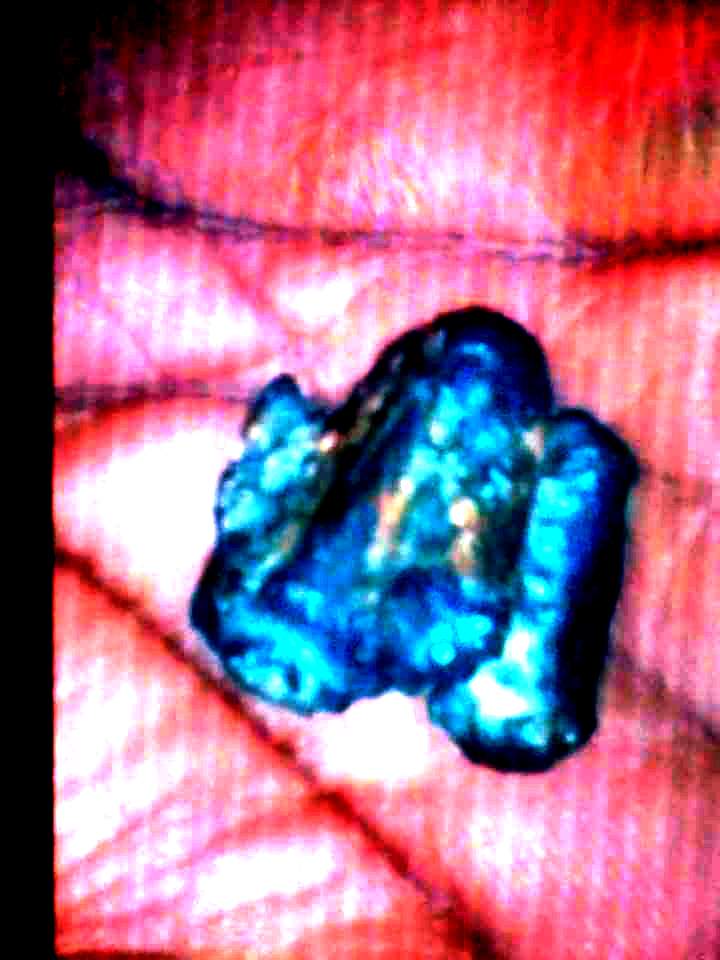
showed no sign of any explosive substance at the scene. Pieces of a rare
kind of stone were found and samples taken for analysis by scientists.
“We
can rule out the possibility of any terror angle or sabotage. Not a
single ingredient pertaining to any kind of explosive was found at the
site. We suspect it to be a meteorite fall,” a top police official told
The Hindu
on Saturday. After a similar blast was reported in a paddy field at
Alangayam in the same district on January 26, a senior Astrophysicist of
the National Physical Laboratory, Ahmedabad, came to the district for a
study. “The scientist was camping nearby and rushed to the college soon
after hearing the news of the blast. We are convinced that it is a
meteorite that fell with high velocity. In the earlier incident, local
people remember having seen an object falling from the sky in the
field,” the official said.
A special team of the Bomb
Detection and Disposal Squad, led by Deputy Superintendent of Police
Asir Vijay Kumar, inspected the scene and ruled out the use of grenades.
Vellore Superintendent of Police Senthilkumari also visited the spot.
Investigators were trying to check if the college had any CCTV camera
covering the disturbed area.